Private pilot · contract review
An AI that never lets the file leave.
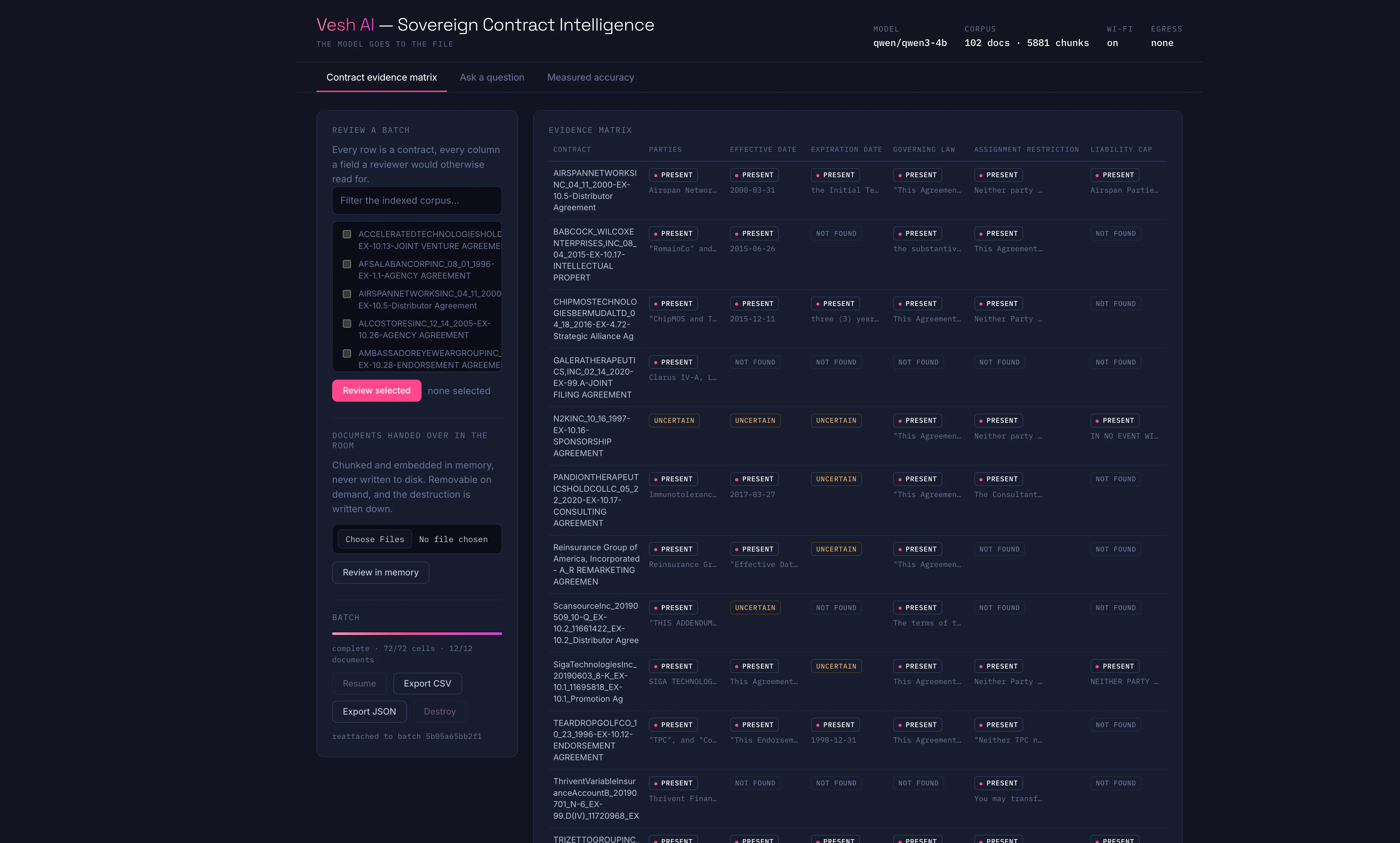
It read 160 contracts in 128 minutes on a laptop. Once its models are installed, the review path calls nothing outside the machine — the material you are forbidden to send anywhere never has to go anywhere.
The week you have now
Somebody still has to read every page.
The diligence set arrives on a Thursday. The tool that could have read it overnight is the tool your client's guidelines forbade, so it is read by hand — by the people you bill at the highest rate. What that costs is not the licence you did not buy. It is the weekend.
Look closer
What it does. And what it will not do.
- 01
Every answer shows its working.
The cell opens the sentence it came from. A reviewer checks a citation instead of re-reading the contract, which is the difference between verifying work and doing it again.
- 02
It would rather say nothing than guess.
An uncertain cell is marked uncertain and left empty. The afternoon goes on the cells it flagged, not on every page it read.
- 03
What comes into the room leaves with it.
Export the matrix, then destroy the corpus. The text, the embeddings and the review decisions go; the record keeps file names and hashes rather than contents, and the destruction is written down.
Measured, not claimed
Not one invented citation.
- Citations valid
- 100%
- Positive claims resolving to indexed source text.
- Precision
- 92.2%
- When the system asserts a field, how often it is right.
960 review cells across 160 contracts it had never seen. Every claim it made resolved to real text in the real document. And when it asserts a field, it is right 92.2% of the time.
Internal held-out evaluation; not an independent audit. Measured on an Apple M4, 12 September 2026.
Current status
A private-pilot MVP.
- Stage
- Private-pilot MVP for supervised contract review
- Users
- Single-user and single-tenant; no authentication yet
- Deployment
- Demonstrated on a single machine under Docker Compose
- Benchmarked on
- Apple M4 laptop with a 10-core GPU and 16 GB of unified memory
- NVIDIA GPUs
- Designed to run on NVIDIA GPU systems; NVIDIA GPU performance has not yet been benchmarked.
- Not yet
- Document-management integration, durable audit log, independent security audit
Private pilot
Bring contracts you are allowed to keep inside the room.
The first step is a bounded diagnostic: identify the review task, agree the held-out checks, and run the evidence matrix inside the boundary. Nothing is installed until you say so.
Diagnostic brief
Day 14 of 14
- 01Where the material actually livesMapped
- 02What must remain a human signatureListed
- 03The runtime, and where it sitsNamed
- 04Risks we found, in plain languageWritten
- 05Price to install, price to keep runningQuoted
Yours to keep — for your board, your IT team or another vendor.